
If you’ve ever launched a SaaS product, you know the feeling. You’ve spent weeks (or months) building something, you finally ship it, and then you stare at your landing page and realize: there’s nothing there that tells a stranger they should trust you.
No testimonials. No reviews. No logos. Just you, your product, and a sign-up button that nobody’s clicking.
I’ve been there. Twice, actually. First with Easy Earnings Tracker and then again when I launched ProofSwap. And the second time around, I decided to actually solve the problem instead of just complaining about it.
In this post, I’m going to break down why getting social proof is so hard for new SaaS products, why the traditional approaches don’t really work, and what I built to fix it.
Table of Contents
- Why Social Proof Is the #1 Growth Blocker for New SaaS Products
- The Traditional Ways to Get Testimonials (And Why They Fall Short)
- Testimonial Exchanges: A Better Model for Indie Hackers and SaaS Founders
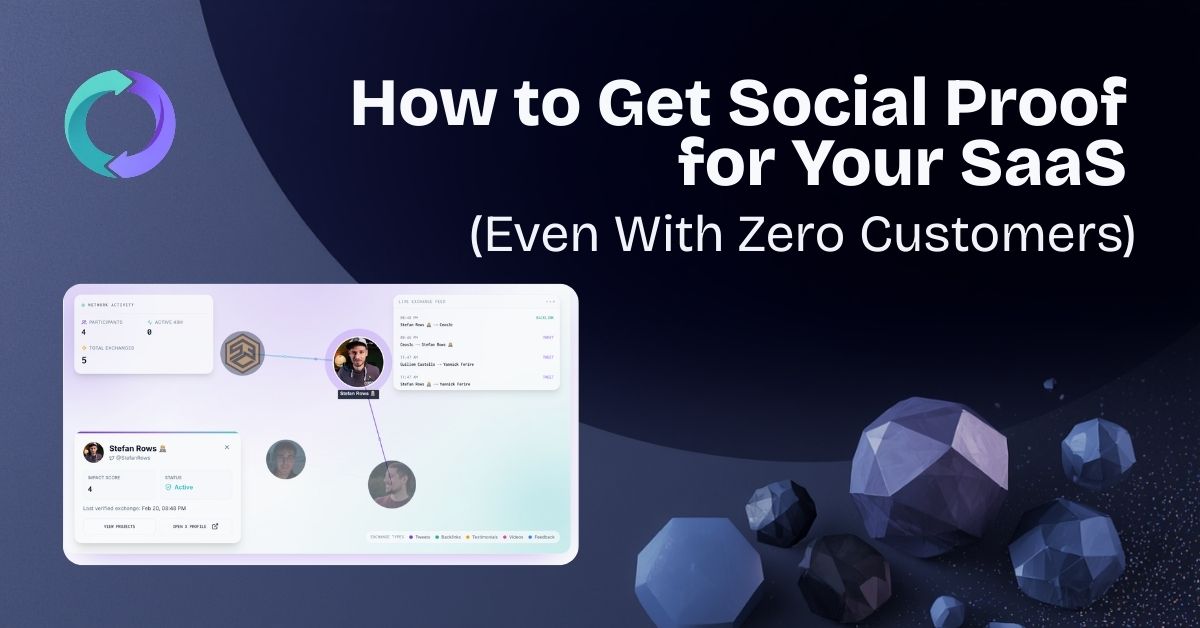
- How ProofSwap Works: Social Proof, Solved
- Beyond Exchanges: 5 Social Proof Strategies That Actually Work in 2026
- Stop Waiting for Social Proof. Start Building It.
Why Social Proof Is the #1 Growth Blocker for New SaaS Products
Here’s the thing… Studies consistently show that around two-thirds of customers are more likely to purchase a product if social proof is present. That’s not surprising. We all do it. Before you buy anything online, you check the reviews. Before you sign up for a tool, you look for testimonials. It’s human nature.
Marc Lou has nailed this in all of his projects.. You’ll fnd an entire WALL of Social Proof on almost all of his sites, take shipfa.st for example.
But here’s where it gets painful for us builders: you need users to get testimonials, but you need testimonials to get users.
This is the classic chicken-and-egg problem, and it hits SaaS founders harder than almost anyone else. If you’re selling a physical product, you can at least send it to a few people for free and ask for a review. But with SaaS? Your potential users look at your landing page, see zero social proof, and bounce. They don’t even give you the chance to prove your product works.
I experienced this firsthand. When I launched Easy Earnings Tracker, my landing page looked clean, the product worked great, but I had nothing to show that anyone else had ever used it. And trust me, people notice. A landing page with zero testimonials screams “nobody uses this” louder than any marketing copy can fix.
The worst part? The bigger tools in your space, the ones you’re competing against, already have hundreds of reviews on G2, Capterra, and their own sites. They don’t have this problem. So you’re not just starting from zero, you’re starting from a disadvantage.
The Traditional Ways to Get Testimonials (And Why They Fall Short)
Let’s be honest about the usual advice you get when you ask “how do I get my first testimonials?” Most of it sounds good in theory and falls apart in practice.
Asking friends and family. Sure, your buddy will say something nice about your app. But a testimonial from “John S.” with no company, no photo, and a suspiciously generic quote like “Great app, very useful!” does more harm than good. It looks fake because, well, it kind of is. Your potential users can smell that from a mile away.
Cold emailing your first users. You finally get a few sign-ups, and now you’re supposed to email them and ask for a testimonial? Most people won’t respond. The ones who do will give you something vague that doesn’t really sell anything. And you feel weird asking because the person literally just signed up two days ago.
Offering free accounts in exchange for reviews. This one’s a bit better, but it still feels transactional. “Hey, I’ll give you my product for free if you say something nice about it.” That’s not exactly the authentic social proof that converts visitors into paying customers.
Listing on ProductHunt or review platforms. Great for a one-time spike, but most early-stage products don’t get enough traction there to build meaningful social proof. And the reviews you do get are often from other makers who tried your app for 5 minutes, not actual users.
The core issue with all of these approaches? There’s no mutual incentive. You’re asking someone to do you a favor with nothing meaningful in return. And humans are wired to think “what’s in it for me?” even when they don’t say it out loud.
Testimonial Exchanges: A Better Model for Indie Hackers and SaaS Founders
So here’s where my brain went: what if instead of begging for testimonials, you could exchange them?
Think about it. There are thousands of indie hackers, solopreneurs, and SaaS founders out there who all have the exact same problem. Everyone needs social proof. Everyone struggles to get it. And everyone is building something that other builders could genuinely try and review.
The concept is simple, you try someone else’s product, leave them an honest, public review (a tweet, a testimonial, a blog mention), and they do the same for you. Both parties get real social proof from a real person who actually used the product.
This isn’t about fake reviews or gaming the system. It’s the opposite. When you actually use someone’s product before reviewing it, you write something specific and authentic. “This tool helped me track my income across 5 platforms” hits completely different than “Great product, would recommend.”
And there’s a built-in accountability mechanism too. If you leave someone a lazy, two-word review, they’re not going to put much effort into reviewing your product either. The reciprocal nature of the exchange naturally pushes both sides toward quality.
I looked around for a platform that did this. Couldn’t find one that worked the way I wanted. So I built one.
How ProofSwap Works: Social Proof, Solved
ProofSwap is the platform I built to solve this exact problem. Here’s how it works:
- You sign up and list your project. Takes about 2 minutes. You describe what your app does and what kind of social proof you’re looking for (a tweet, a testimonial, a backlink, etc.).
- You browse other projects. Find something that interests you, try it out, and leave them honest social proof, a public tweet, a review, whatever was agreed upon.
- They verify and return the favor. The other maker checks that you actually posted the review, and then they do the same for your product.
That’s it. No complicated credit systems, no waiting around for months hoping someone notices your listing. It’s a direct exchange between real builders who understand each other’s struggle because they’re living it too.
The platform is built with Next.js, Supabase, and deployed on Vercel, the same stack I use for all my projects. And it’s completely free to use. I built this because I needed it myself, and I figured if I have this problem, thousands of other builders do too.
Beyond Exchanges: 5 Social Proof Strategies That Actually Work in 2026
ProofSwap solves a big piece of the puzzle, but it shouldn’t be your only strategy. Here are five other approaches that I’ve either used myself or seen work really well for early-stage SaaS products:
Build in public. Share your journey on X, on Indie Hackers, wherever your audience hangs out. When people see the process behind the product, they develop trust before they ever sign up. This is basically social proof through transparency. I’ve been doing this with both Easy Earnings Tracker and ProofSwap, and the engagement you get from genuine building-in-public posts is way more valuable than any ad spend.
Leverage micro-communities. Reddit, Discord servers, niche Slack groups, these are goldmines. Don’t spam them with your product link. Answer questions, provide value, and mention your product naturally when it’s relevant. One authentic recommendation in the right community is worth more than 100 generic testimonials.
Use user-generated content strategically. If someone tweets about your product, screenshot it. If someone shares feedback in your DMs, ask if you can use it (with their permission, obviously). These raw, unpolished endorsements often convert better than professionally written testimonials because they feel real.
Embed proof at every conversion point. Don’t just slap testimonials on a dedicated page that nobody visits. Put them next to your sign-up button, on your pricing page, in your onboarding emails. A single relevant testimonial placed next to your CTA converts better than a “Wall of Love” buried three clicks deep.
Stack multiple types of social proof. A testimonial alone is good. A testimonial plus a ProductHunt badge plus a “Used by 50+ developers” counter? That’s a trust cocktail. Even small numbers work if you frame them right, “Trusted by indie developers building their first SaaS” sounds way better than hiding the fact that you have 47 users.
Stop Waiting for Social Proof. Start Building It.
If you’re sitting there with a launched product and zero testimonials, I get it. I’ve been exactly where you are. The temptation is to wait until the social proof “happens organically.” Spoiler: it won’t. At least not fast enough.
Social proof is not something that happens to you. It’s something you build, intentionally, from day one. And the fastest way to kickstart it when you have zero customers is to exchange it with other builders who face the exact same problem.
That’s why I built ProofSwap. It’s free, it takes 2 minutes to list your project, and you could have your first real testimonial by the end of the week.
If you’re an indie hacker, a solopreneur, or a SaaS founder struggling with the social proof chicken-and-egg problem, give it a shot. And if you have any questions, hit me up on X or drop a comment below.
Now stop reading and go get some social proof. 🤝
